


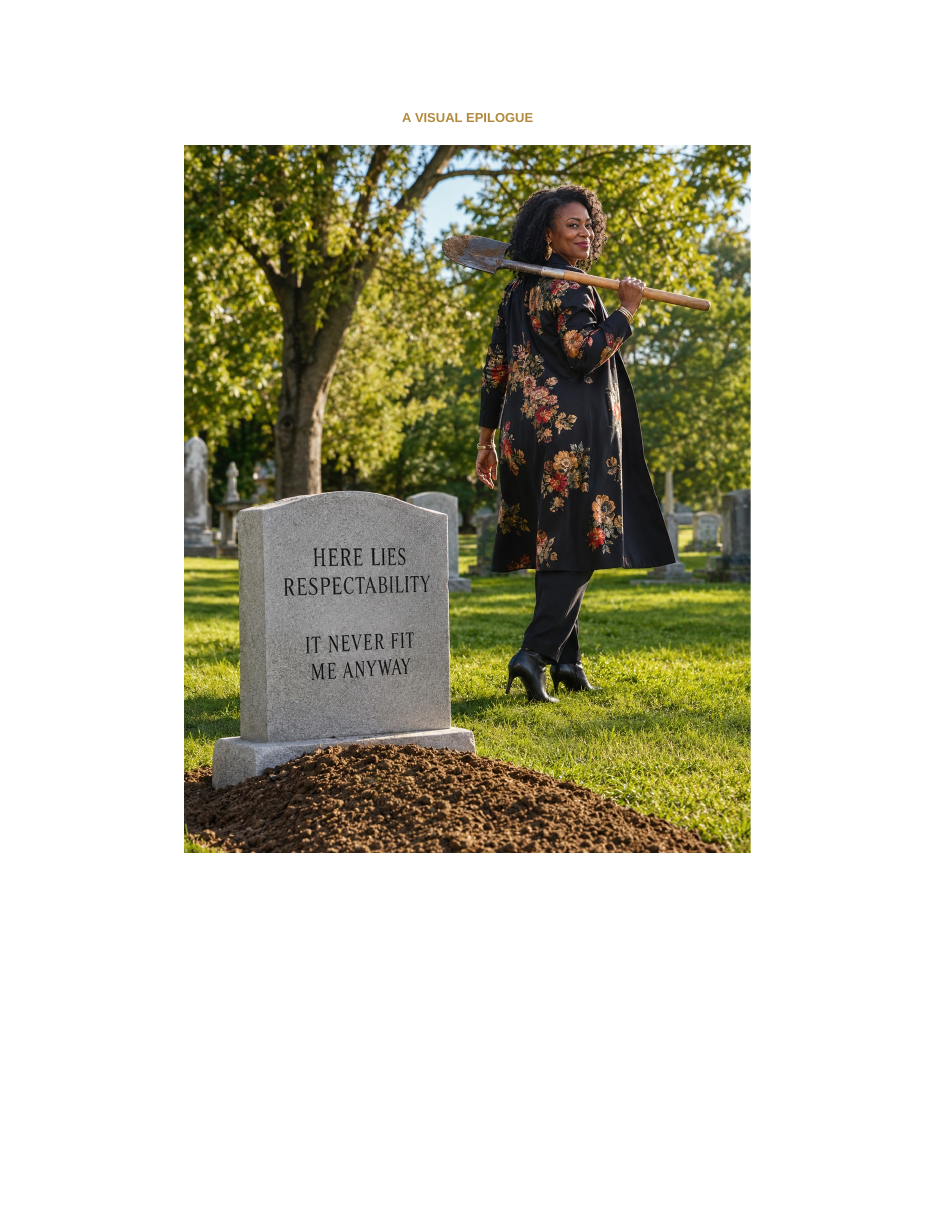
Here Lies Respectability: It Never Fit Me Anyway
Updated: Sep 4

Respectability brought its gloves, pearls and rules. I brought my full weight.
This is the visual essay as it was meant to be seen. Read it in the viewer below, open the PDF in a new tab, or continue to the web-text edition that follows.
Web-Text Edition
On Black women, labour, academia—and the costly games that ask somebody to stay down so somebody else can rise.
By Carla Rodney
I have been thinking about seesaws.
They are strange little machines. One person rises because somebody else agrees to go down. The game works only as long as both bodies accept their turn at being lowered.
I have never played well at games that require me to stay down so somebody else can enjoy the height.
Perhaps that is why respectability and I have never got along.
The Rules at the Other End
Respectability has never known what to do with a Black woman it cannot shame, blame, shrink, fuck or put to work.
I am coarse—if by coarse you mean unwilling to sand myself down to the texture you prefer. I am confident. I am beautiful. I am too many shades too dark, too many inches too tall and an octave too loud. My presence enters the room before anyone has had time to prepare an appropriate place for it.
And I do not bend.
In fact, I enjoy being dominant. I wear it well.
Some people have looked at me and seen only two possible uses: my labour or my vagina. My mind was the inconvenient third possibility—the part I was expected to tuck away so it would not interfere with their interests.
But even the vagina brings us back to labour.
Sex. Birth. Mothering. Caregiving.
The production and maintenance of entire generations.
And there it is: capitalism.
Capitalism has always been remarkably creative when finding ways not to pay Black women. Whiteness has always loved getting something for nothing—especially when the something is a Black woman.
Our bodies. Our brains. Our babies. Our backs.
The unpaid labour it has tried to tear from my folds.
Capitalism Changes Costumes
Capitalism did not disappear when I entered university. It simply put on a robe, handed me a student number and called itself opportunity.
When my labour was paid by the day, I knew I was working. I worked hard. I played hard. And whatever society thought of the choices I made, I owned me.
Then I became an academic and slowly stopped feeling as though I belonged to myself.
I entered as a tall, mature, disabled Black woman. A mother. A grandmother. A grieving woman. A scholar who had already lived enough life to know that intelligence does not begin when an institution agrees to recognize it.
The institution found the easiest part of me to understand:
My student number.
There were offices to visit and people supposedly available to help me make choices. There were policies, pathways and promises. Institutional delights everywhere—attractions without substance.
A map of offices is not the same thing as support.
The university could advise me, redirect me, delay me and disappear on me. But when those choices proved harmful, the accountability fell neatly at my feet.
Academia is a road of suffering when travelled alone, and institutions have perfected the art of leaving people alone in crowded hallways.
The Bill Comes Due
You Do Not Own Your Ass Yet
For those who enter without resources, education is sold as the road to somewhere better. But when the road collapses, the institution does not come looking for you. Good experience or bad, it becomes your problem the moment they hand you back your ass with a piece of paper.
They do not guide you in.
They do not hook you up.
Instead, the phone calls begin.
You do not own your ass yet.
Do not rest.
Do not sleep.
You owe.
No support. Just expectations.
And if you fall short, you may become one of the very people academics write about—only without the PhD, the credentials or the protection those letters were supposed to provide.
Academia loves to study people living on the street. It is less interested in asking how many arrived there while pursuing the papers that were supposed to save them.
Some were not ruined because they refused education.
The pursuit of it helped ruin them.
Paper is a poor roof.
The institution keeps the research, the reputation and the revenue. You keep the debt, the damage and the responsibility for somehow turning it all into a good experience.
If you survive, your survival may even be offered as evidence that the system worked.
It did not.
My survival proves that I survived. It does not prove that what happened to me was acceptable.
Let Respectability Dangle
Which brings me back to the seesaw.
Respectability sits at one end with its white gloves, polished pearls, pretty promises and rules about how a Black woman should speak, sit, think, grieve and suffer.
I am seated at the other.
I have spent enough of my life serving as the counterweight to somebody else’s comfort. I will not keep my side lowered so whiteness can feel tall. I will not disguise my mind, soften my voice or apologize for the weight of my presence.
Let the gloves and pearls dangle in the air.
Let capitalism feel my full weight.
Let academia discover that the body it reduced to a number still has a name.
I own me.
The Conversation Continues
If this piece puts language to something you have lived, leave a comment. Respectability depends upon silence; relationship begins when we tell the truth and discover we were not alone.
Keep reading on Grandma Knows Best
If this resonated, continue with the pieces on authority, survival, and what Black women are asked to surrender in order to be accepted.


Comments