


The Family That Goes Out Together — Stays Together?
Updated: Aug 22

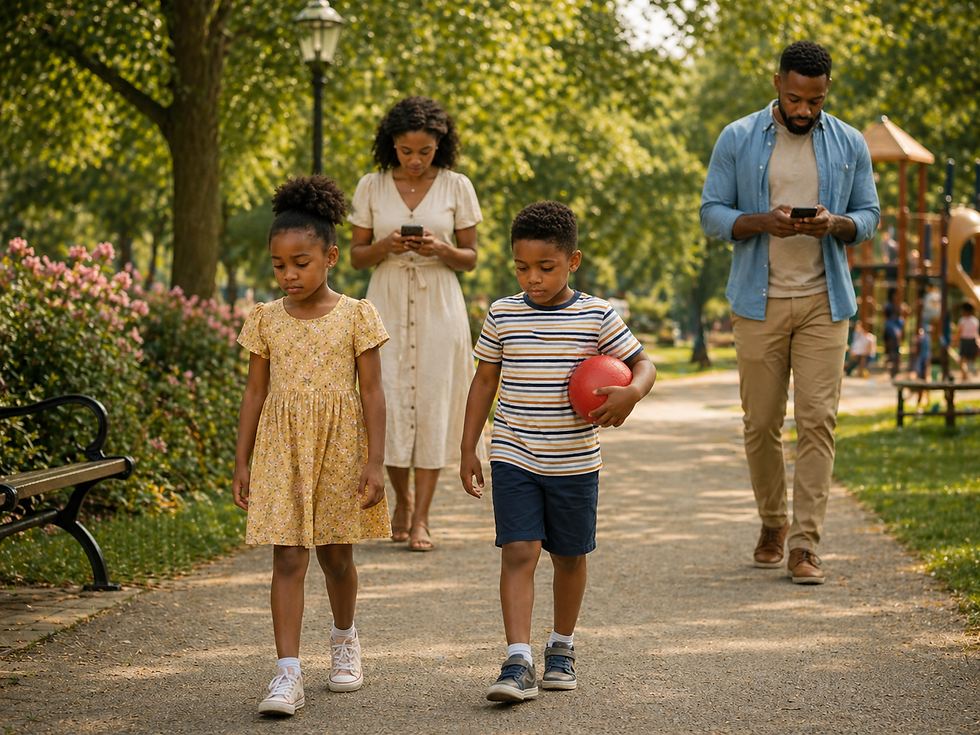
There was a time when a family outing meant more than simply leaving the house at the same time.
It meant hand-holding. Children watched closely. Snacks packed. Someone remembered the napkins, usually after someone else forgot them, and Mom had something to say about it. A ball might be brought along, or a blanket, or sandwiches wrapped with care. The park was not just a place to send children off while adults disappeared into another world. It was where children learned how to climb, share, fall, get back up, wait their turn, and occasionally cry because someone else got the better swing.
In other words, family outings were not always glamorous, but they were alive.
As a mother, grandmother, and human being, I find myself increasingly struck by the contrast between the family outings of yesteryear and some of what I see today. I remember families walking together in almost storybook fashion, children holding onto their parents’ hands, sometimes pulling them enthusiastically toward the park or whatever adventure the day held. Parents held firmly to those little hands, guiding, playing, teaching, correcting, laughing, and staying close enough to be involved.
Sometimes there were extra toys. Sometimes there was a picnic. Sometimes there was no money for anything fancy, but there was still a sense of intimacy, shared presence, and interaction.
Now, more often than I care to admit, I see families out together but not quite together.
The children walk ahead or behind. The adults walk separately, heads down, holding cell phones as though they contain oxygen. The outing is happening, technically. The family has left the house together, yet separately. Later, everyone may even appear in the same photo, posing as though togetherness happened.
But the question remains: are they actually together?
And unfortunately, this scene is not only about families. I have seen lovers and dates behaving similarly, too.
It happens on the bus. Once upon a time, people looked out the window. They noticed the weather, the buildings, the people, the changing neighbourhoods, and the strange little dramas that unfold when human beings are forced to share public space. Now, buses are often filled with bowed heads and glowing screens. Whole streets pass by without being seen.
On sidewalks, people walk while staring into their phones. Some cross streets without lifting their eyes, trusting that traffic, fate, and possibly the ancestors will make accommodations for them. I have seen people step into the road with the confidence of someone who believes a notification is more urgent than a moving vehicle.
That, to me, is concerning.
My alarm is not ringing because I am against technology. I am not. Phones are useful. I have one. They help us call for help, find directions, take photographs, check on loved ones, read the news, listen to music, and occasionally avoid speaking to someone when we simply do not have the emotional strength.
Let us be honest. There are days when the phone is not the problem. It is the shield.
But somewhere along the way, the tool of progress became a pattern of dependency. The habit became a reflex, and the reflex began replacing presence. What began as convenience now sometimes looks like compulsion.
We no longer simply use our phones. Too often, we disappear into them.
Social occasions have changed too. People still gather, but conversation sometimes struggles to find its way into the room. There are awkward pauses where curiosity used to live. A birthday, dinner, family visit, or community event can slowly become a collection of private islands, each person present in body but quietly pulled elsewhere by a screen.
There is something almost funny about it, if it were not also sad. We dress up to go out, arrive at the same place, sit with people we supposedly wanted to see, and then spend half the time looking at people who are not there.
The absent get our attention.
The present get our leftovers.
And children notice while they go unnoticed.
Children observe when the phone gets answered faster than their question. They notice when a parent’s face lights up for a screen but stays tired for them. They notice when the walk to the park is not a walk together, but a commute between distractions. They may not have the words for it, but they feel the difference between being supervised and being accompanied.
There is a difference.
A child can be watched without being deeply seen. A family can be outside without being connected. People can gather without truly meeting.
That is the caution.
The concern is not that families own phones. The concern is that modern life has made it easier to be physically present while emotionally absent. We can now sit beside each other and be miles away. We can walk together and not share the walk. We can take children to the park and miss the very memories we meant to create.
And the tragedy is that so many of these moments do not look important while they are happening.
A child’s hand reaching for yours. A bus ride through your own city. A conversation at the table. A friend’s face changing when they are trying not to cry. A grandchild asking a question that seems small but is really an invitation. A sunny afternoon. A slow walk. A shared laugh.
These are the moments that make a life feel held.
They rarely announce themselves as sacred. They usually arrive disguised as ordinary.
Maybe that is why we miss them.
We are trained now to respond to the urgent: the buzz, the ping, the message, the headline, the little red circle telling us something is waiting. But much of what matters does not buzz. It waits quietly. It sits across from us. It walks beside us. It looks up at us from a stroller, a park bench, a dinner table, or the other side of the couch.
And if we are not careful, we will keep missing it.
This is not a call to throw away every phone and return to some imaginary perfect past. The past was not perfect. Families had troubles then, too. Parents were tired then, too. Children were ignored in other ways. Loneliness did not begin with the smartphone.
But something has shifted, and pretending otherwise does not help us.
The family outing, the bus ride, the walk down the street, the social visit — these are small public classrooms where we learn how to be human with one another. We learn patience. We learn awareness. We learn conversation. We learn safety. We learn how to notice. We learn how to belong.
When everyone is looking down, what happens to those lessons?
What happens to children who grow up seeing distraction as normal? What happens to friendships when people forget how to sit through a pause? What happens to the community when we stop noticing who is around us? What happens to safety when pedestrians trust screens more than streets?
Perhaps the answer is not dramatic. Perhaps it begins simply.
Look up.
Look out the bus window.
Hold the child’s hand.
Put the phone away for the length of a meal.
Cross the street with both eyes involved in the decision.
Let a family outing become an outing again, not just a change of location for everyone’s individual screen time.
We do not need to make presence complicated. It can be small. A sandwich in a bag. A ball in the park. A walk without scrolling. A conversation without competing with notifications. A child knowing that, for this moment, they do not have to fight a phone for the attention of someone they love.
The family that goes out together may grow into staying together.
But only if they are actually there.
Something has shifted in how families move together — and this piece names it gently.
Coffee, Some Tea, and GKB is where I write about family, memory, and the small things that hold people close or let them drift. Subscribe and receive 10 Approved Grandma Sayings as a welcome gift. Some conversations are better held over something warm, with someone you love nearby.
Pull your people closer.


Comments