


When Black Joy Meets White Rage – A Song for Survival, whilst being young, gifted and Black
- Carla Rodney

- Aug 12, 2025
- 3 min read
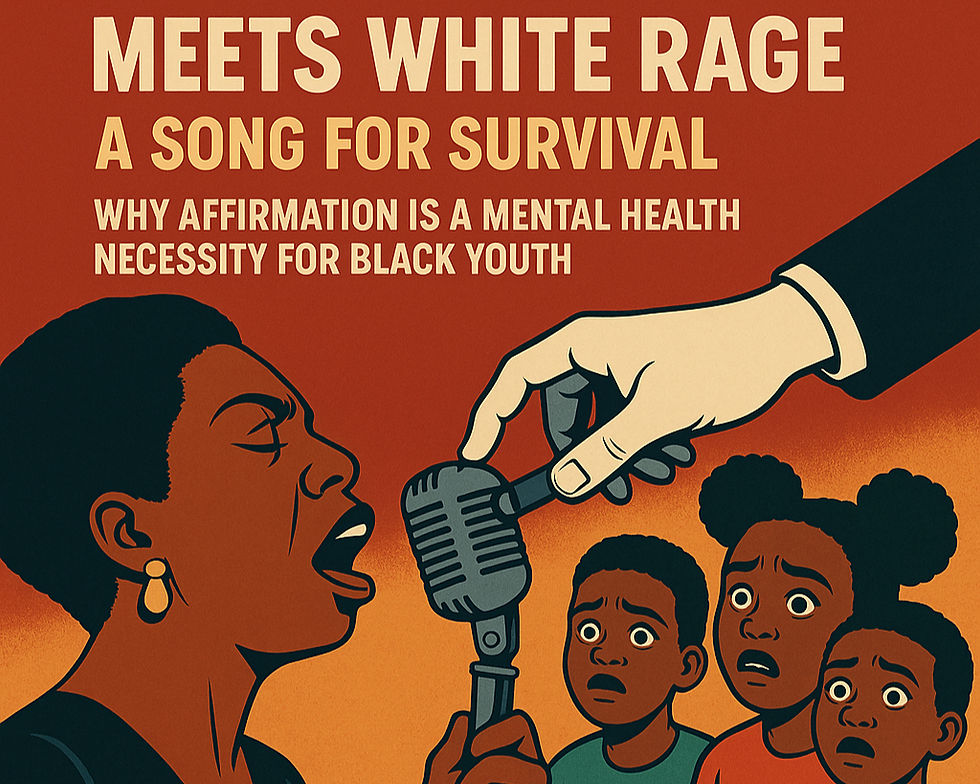
Why Affirmation Is a Mental Health Necessity for Black Youth
Imagine waking each morning to the words: To be young, gifted, and Black. Not as a slogan hanging flat on a poster, but as an anthem — alive — filling your home, your heart, and your mind. What would it mean for you to start the day wrapped in that message? To hear it before you hear the world? How might it steady your spirit in a society that so rarely reflects your full humanity back to you, or mirrors Black beauty in its truest form?
Affirmations like this matter. They are your protection, your reminder, your refusal to forget who you are and that you matter. They are the daily hand on your shoulder saying, You belong here. Yet there is also a reality you may face when you walk in your power — unapologetic and self-assured, as so many others teach their children to be. We can and must gift our children that same confidence, but for us, that joy and self-worth can ignite what Carol Anderson calls white rage — a fire that burns brightest when we rise. Dorothy Roberts gives it another name in Killing the Black Body: the machinery of control, punishment, and erasure aimed at Black life — in body, mind, and spirit.
This tension — between the gift of affirmation and the cost of holding it — is the backdrop for understanding why songs like “To Be Young, Gifted and Black” are more than music; they are medicine.
The Mental Health Power of Cultural Affirmation
A song like “To Be Young, Gifted and Black” doesn’t just celebrate identity — it names your worth in a world that tries to deny it. For Black youth, such affirmations are not luxuries; they are mental health necessities. They counter the slow erosion caused by representation gaps, internalized stereotypes, and the daily accumulation of micro- and macro-aggressions — injuries that may be invisible but are deeply felt.
Nina Simone understood this when she asked her collaborator, Weldon Irvine, to write lyrics that would “make Black children all over the world feel good about themselves forever.” The song was born to honor her close friend Lorraine Hansberry, who first coined the phrase in 1964. It was both a memorial and a message: your Blackness, your youth, and your gifts are strengths, not liabilities.
When Empowerment Sparks Backlash
As Carol Anderson writes in White Rage, it is not Black failure but Black success that often triggers the harshest reactions. History is full of examples: policy rollbacks after civil rights gains, school closures following desegregation orders, voter suppression after increased Black political participation. Empowerment is met with resistance, not by accident but by design.
Dorothy Roberts’ work expands this, revealing how control over Black bodies — particularly Black women’s bodies — has been a tool to limit autonomy and agency. This control shows up in many forms: in policing, education, healthcare, housing, and the economic systems that shape daily life.
Violence as a Maintenance Strategy
When you connect Anderson’s and Roberts’ insights, a pattern emerges: the same systems that deny opportunity also respond to empowerment with violence — not always physical, but structural, economic, and psychological. This violence is a maintenance strategy. It keeps trauma alive, ensures it is inherited, and makes healing itself a radical act.
Art as Resistance and Healing
This is why a song like “To Be Young, Gifted and Black” is more than art. It is an act of resistance. It says to you: Even in the face of rage — whether from individuals, institutions, or policy — your life will continue to affirm itself.
Simone’s hope was for the song to echo across generations, offering pride and possibility to those who had not lived through her time but still needed its affirmation. Over the years, it has been covered by artists like Aretha Franklin and Elton John, each adding to its reach. It has become a beacon for identity, dignity, and self-definition.
For you — and for Black youth everywhere — hearing, singing, and believing To Be Young, Gifted and Black is more than a cultural moment. It is mental health care. It is a shield for your mind and a seed for your liberation. If trauma is maintained by design, then so too must our healing — deliberate, sustained, and passed forward in our voices, our art, and our songs.


Comments