


If Dorothy Roberts Were a Class
Updated: Sep 4
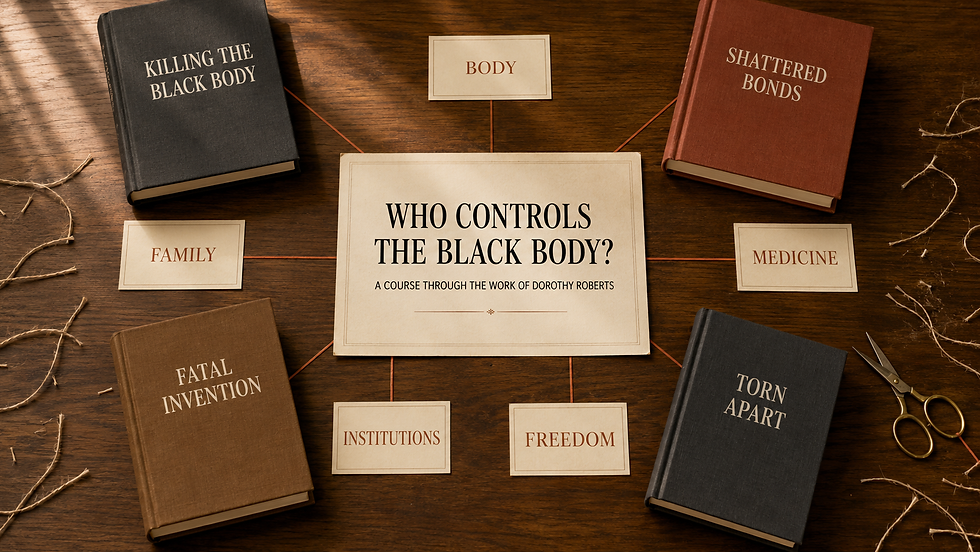
I was sitting with Dorothy Roberts’s Killing the Black Body when a question came to me: what if Dorothy Roberts were a class?
Not a guest lecture.
Not one assigned chapter tucked into a week on race.
Not a brief appearance in a course whose central assumptions remain untouched.
What if her body of work formed the foundation of an entire course?
I began imagining that course because Roberts’s books do more than address several important subjects. Read together, four of them form one sustained argument about how power moves.
Killing the Black Body (1997) asks who is permitted to control a Black woman’s body. Shattered Bonds (2001) asks what happens when the state turns that control toward Black families. Fatal Invention (2011) examines how science and medicine can revive race as though it were biological fact. Torn Apart (2022) returns to the family, names the child-welfare system as a family-policing system, and asks us to imagine safety without surveillance and separation.
Body. Family. Science. Institution.
One book hands its central question to the next.
Universities usually separate these subjects. Reproduction appears in women’s and gender studies. Child welfare belongs to social work. Race and genetics are left to medicine, public health, or bioethics. Legal questions stay in law school. Abolition appears in Black studies or criminology, if it appears at all.
Roberts’s work refuses that separation. It shows that these are not unrelated areas of study. They are connected parts of a longer history in which institutions acquire the power to classify, monitor, correct, punish, remove, and sometimes destroy—while describing what they are doing as care.
That is the class I want to describe.
Who Controls the Black Body?
Race, reproduction, family policing, science, and freedom in the work of Dorothy Roberts
This would not be a course designed simply to introduce students to a respected scholar. It would ask them to use Roberts’s work as a method: to study what institutions say they do, compare that claim with the power they actually exercise, and notice who becomes vulnerable when care and control are treated as the same thing.
The course would begin with a rule:
No institution gets to use its stated purpose as proof of its actual effect.
A hospital is not caring simply because it calls itself a place of care. A child-welfare agency is not protecting children simply because protection appears in its name. A university is not inclusive because inclusion appears in its mission statement. Students would have to look at what each institution does, who it believes, who it watches, what it requires from the people seeking help, and what happens when those people resist.
That rule would carry us through every unit.
Unit One: Black women’s bodies as political territory
The course would open with Killing the Black Body: Race, Reproduction, and the Meaning of Liberty—not as a closed history of terrible things that happened long ago, but as a study of how Black women’s bodies have repeatedly been made into public property and political territory. Students would examine forced reproduction under slavery, sterilization abuse, medical exploitation, welfare policy, the punishment and surveillance of pregnant women, and the racial stories used to make each intervention appear reasonable.
The history matters because control does not always announce itself as violence. Sometimes it arrives as treatment. Sometimes as public health. Sometimes as protection, professional expertise, fiscal responsibility, or concern for a child not yet born.
Institutions build authority by first building a story about the people they intend to control. Black women have been described as irresponsible, hyperfertile, negligent, sexually reckless, insufficiently maternal, and incapable of making sound decisions. Once the description is accepted, intervention starts to look necessary. The question quietly shifts from whether an institution has the right to interfere to how much interference can be justified.
The language changes. The arrangement survives.
This unit would also challenge the narrow version of reproductive freedom that treats it mainly as the right to avoid or end a pregnancy. Black women developed the reproductive-justice framework because “choice” could not contain the whole problem. Freedom also includes bodily autonomy, the right to have children, the right not to have children, and the right to raise the children we have in safe and sustainable communities.
Black women have been denied freedom in both directions: compelled to reproduce at some historical moments, discouraged or prevented at others, punished for becoming mothers, and separated from the children they did have.
The body is never only a body in this history. It becomes a workplace, a medical subject, a policy problem, a site of profit, a crime scene, and a battleground over who gets to decide.
A class built on Roberts would ask students to notice something else: institutions can make coercion difficult to name by placing it inside an offer of help. A pregnant woman may enter a hospital seeking treatment and find herself subjected to surveillance. A poor mother may ask for assistance and discover that her request has opened her home to inspection. The door marked care can lead somewhere very different from where the person seeking help thought she was going.
This is not an argument that every intervention is malicious or every professional is cruel. It is an argument that good intentions do not cancel unequal power.
Unit Two: When child welfare becomes family policing
The course would then move to Shattered Bonds: The Color of Child Welfare and Torn Apart: How the Child Welfare System Destroys Black Families—and How Abolition Can Build a Safer World.
Here, the question of control moves from the Black woman’s body to the Black family.
Students would be asked to sit with the difference between helping a family and policing one.
Why is poverty so often translated into parental failure? Why are families punished for inadequate housing, insufficient income, disability, food insecurity, or lack of access to child care? Why must parents frequently prove their deservingness before receiving support? Why does the state so often respond to hardship by investigating the family rather than repairing the conditions producing the hardship?
Even federal child-welfare guidance now stresses the need to distinguish poverty from neglect. That distinction should be obvious, yet its continued urgency tells us how often material deprivation is still read as moral deficiency.
A parent cannot buy food, and the file says neglect.
A family is living in unsafe housing, and the file says risk.
A mother is overwhelmed and asks for help, and the system begins documenting whether she is fit.
The institutional vocabulary—best interests, safety, risk, compliance, neglect, fitness—sounds neutral and responsible. It can also conceal an enormous amount of power. Who defines neglect? Who decides what risk looks like? Whose home counts as unsafe? Whose hardship is understood as temporary and structural, and whose is entered into a permanent record as evidence of personal failure?
The course would not pretend that children are never harmed or that families never need intervention. That would be too easy, and it would avoid the harder question Roberts places before us: does a system become protective merely because some children need protection?
We can care about children and still ask whether investigation, surveillance, removal, and foster placement have become the default tools for responding to problems that might be better addressed with money, housing, health care, disability support, child care, kinship support, or respite.
We can oppose abuse without confusing poverty with danger.
We can want children to be safe without assuming that safety must be delivered through the threat of family separation.
Roberts calls the system family policing because she wants us to see what the softer name can hide. The term shifts our attention from the agency’s declared intention to the family’s encounter with state power. It asks us to notice that a knock at the door may feel less like help when the person knocking can question your children, search your home, judge your relationships, demand compliance, and initiate the process that removes a child.
This unit would train students to ask not only, “Was procedure followed?” but also, “What kind of relationship did the procedure create?”
Was support offered freely, or attached to surveillance?
Was the family’s testimony treated as knowledge, or merely entered as data?
Did intervention increase safety, or did it rearrange the harm?
Unit Three: When race enters the formula
Using Fatal Invention: How Science, Politics, and Big Business Re-create Race in the Twenty-first Century, the course would turn to genetics, medicine, and biotechnology.
Students would examine a contradiction. Modern genetics has made it increasingly difficult to defend the old idea of humanity divided into fixed, naturally distinct races. Yet race still appears in research, clinical tools, drug development, and medical decision-making as though it were a stable biological variable.
The National Academies has warned researchers not to use race as a proxy for human genetic variation. That recommendation matters because a social category does not become biological simply because it has been entered into a dataset.
Race can still predict health outcomes—not because racial categories reveal separate kinds of human bodies, but because racism shapes exposure to stress, pollution, poverty, inadequate care, medical dismissal, and other conditions that reach the body. The fact that racism becomes physical does not make race biological.
The anchoring case for this unit would be the estimated glomerular filtration rate, or eGFR, used to assess kidney function. Older equations, including the widely used 2009 CKD-EPI creatinine equation, included a coefficient for patients classified as Black. With the same age, sex, and creatinine level, the formula produced a higher estimate for a Black patient than for a non-Black patient.
That difference was not merely descriptive. Clinical decisions often depend on thresholds. A higher reported eGFR could delay the classification of chronic kidney disease or affect the timing of specialist referral and transplant evaluation.
No clinician had to express a racist belief for race to influence the result. The decision had already been placed inside the formula.
In 2021, a joint National Kidney Foundation–American Society of Nephrology task force recommended immediate adoption of a new race-free equation. The change did not prove that mathematics is untrustworthy. It proved that mathematics contains human decisions: which populations are grouped together, which variables are treated as natural, which outcomes are prioritized, and which assumptions disappear from view once a tool is described as objective.
This is precisely the kind of question Fatal Invention teaches students to ask.
What work is the category of race doing?
Is it describing genetic ancestry, lived exposure, unequal treatment, or some unstable mixture of all three?
Who benefits when inequality is explained through biology rather than history?
What happens when racism is removed from the explanation but race remains in the calculation?
Students in medicine and public health need these questions before they are given authority over patients. Students in law and policy need them before they decide what counts as evidence. And all students need them before the language of innovation persuades them that a newer tool is necessarily a fairer one.
Science does not stand outside society. Its categories, funding, research questions, datasets, and commercial ambitions come from somewhere. Roberts asks us to look at that somewhere.
Unit Four: Institutions that call themselves caring
This unit would hold the entire course together.
Hospitals, universities, child-welfare agencies, courts, prisons, social-assistance systems, and schools all describe themselves as serving, protecting, treating, supporting, or educating the people in their care.
The question is what happens when the institution offering help is also the institution with the power to monitor, classify, discipline, disbelieve, or remove.
Roberts’s scholarship gives students a way to read almost any institution:
What does this institution say it does?
What power does it actually hold?
Who is believed, and who is watched?
Who is granted privacy and innocence by default?
Who must repeatedly prove that they were harmed?
Who is praised for resilience because acknowledging what injured them would make the institution responsible?
A university can teach social justice while marginalizing the students who ask it to practise what it teaches. A hospital can speak the language of treatment while dismissing a Black patient’s pain. A social-assistance system can promise support while organizing a person’s life around suspicion and proof. A child-welfare agency can speak the language of protection while making family separation its most powerful response.
The language of care does not guarantee the practice of care.
That may be the most important lesson in the course.
It would also be one of the most uncomfortable, because students are often trained to identify with the helping profession they hope to enter. They learn the institution’s ethics, procedures, and vocabulary. They are told what the profession is for. They may not be taught to recognize how quickly professional certainty can turn another person’s life into a case.
This class would not ask students to abandon care. It would ask them to become more accountable for the power carried in its name.
Care without consent can become control.
Protection without material support can become punishment.
Expertise without humility can become another way of silencing the person who knows the institution from underneath.
Unit Five: Black feminist thought as method
Roberts does not write in isolation, and the course should not teach her that way.
Her work belongs to a Black feminist intellectual tradition that refuses to treat race, gender, class, disability, sexuality, family, and state power as separate problems that happen to collide now and then. These forces work through one another.
Patricia Hill Collins’s matrix of domination helps explain why a Black mother’s experience of the child-welfare system cannot be understood as “race plus gender plus poverty,” as though each category could be examined alone and the results added together later. Power is organized through their interaction.
A judgment about an “unsafe home” may be shaped at once by race, class, gender, disability, neighbourhood, and ideas about respectable motherhood. That is why the same hardship can be read as a private family struggle in one home and evidence of unfitness in another.
Kimberlé Crenshaw’s work on intersectionality helps students see a related failure. A reproductive-rights framework built around the experience of white, middle-class women may defend freedom from forced motherhood while having little language for Black women’s experiences of sterilization, family separation, criminalization, or the struggle to raise children safely. A racial-justice framework centred on Black men may overlook the particular ways Black women encounter policing through hospitals, welfare offices, maternity care, and family courts.
Single-axis thinking does not merely leave some people out of the example. It can make their harm unintelligible.
Reading Collins and Crenshaw alongside Roberts would show students that Black feminist thought is not an optional perspective added after the “main” theory has been taught. It is a method for finding what the main theory could not see.
It asks different questions because it begins from lives that institutions have repeatedly treated as peripheral.
Who disappears when the category is too simple?
Whose experience is treated as an exception?
What does the person living at the intersection know that the institution studying one road at a time does not?
What students would have to do—not only read
This course should not rely only on conventional essays. If students are being taught to recognize institutional power, they should have to examine the systems around them.
Institutional language audit
Students would choose a policy from a university, hospital, child-welfare agency, school, or government office. They would identify words such as care, safety, resilience, risk, compliance, neglect, and protection, then ask what those words authorize.
What becomes possible once a person is classified as risky?
What institutional responsibility disappears when a harmed person is praised for resilience?
What violence goes unnoticed when the institution is permitted to call itself protective?
History-to-present case study
Students would trace one historical practice into a contemporary system: forced reproduction under slavery and later forms of reproductive coercion; sterilization abuse and present-day medical control; the destruction of Black families under slavery and contemporary family separation; scientific racism and race-based medical technologies; welfare surveillance and modern social-assistance monitoring.
The purpose would not be to claim that nothing has changed.
The purpose would be to study how power changes its methods, updates its vocabulary, and preserves some of its targets.
Testimony archive
Institutions document themselves more reliably than they document the people they act upon. Policies survive. Annual reports survive. Mission statements, case numbers, and procedural records survive.
The voices of the students, patients, mothers, and families touched by those policies are easier to scatter.
Students would gather public testimony from legal records, community reports, hearings, memoirs, oral histories, and interviews. They would compare what an institution says it does with what people say they experienced.
Testimony would not be treated as decorative emotion placed beside the “real” evidence. It would be treated as evidence about how power is encountered.
Design toward abolition
The final assignment would ask students to redesign a system—a response to family crisis, a university complaint process, a maternal-health program—using a premise that is not neutral:
Safety and material support, rather than surveillance and removal, should be the default response to hardship.
That premise comes directly from the abolitionist direction of Torn Apart, and the course should say so plainly rather than pretending students arrived at it from nowhere.
Abolition here would not mean doing nothing. It would mean refusing to confuse an existing institution with the human need it claims to meet. Children need safety; that does not prove the current child-welfare system is the only way to provide it. People need health care; that does not make every medical practice caring. Students need education; that does not make every university arrangement just.
The assignment would ask: what would we build if the people receiving support were not first treated as threats, failures, or problems to be managed?
Who needs this course?
Certainly students in law, social work, medicine, nursing, public health, education, public policy, criminology, women’s and gender studies, and Black studies.
But the better answer may be: anyone who will be given professional authority to decide what risk means in another person’s life.
Anyone who will write a policy, complete an assessment, interpret a test, investigate a home, review a complaint, approve a benefit, evaluate a parent, or decide whose account is credible.
The course would be especially important for students entering helping professions because power is not made harmless by benevolent intention. In fact, some of the most durable forms of control are protected by the belief that the people exercising them are only trying to help.
That belief can make self-examination feel unnecessary.
Roberts makes it necessary.
Why this course matters
Many people meet these systems before they have language for them.
They know something feels wrong. They know the institution’s explanation does not match what happened. They know the help they were promised is beginning to feel like monitoring, suspicion, or discipline. But without history, theory, and the testimony of others, they may experience that contradiction as a private failure.
Maybe I am being difficult.
Maybe I misunderstood.
Maybe this is simply how care works.
A course built on Roberts’s scholarship could interrupt that isolation. It could help social workers tell the difference between assisting a family and policing one. It could help medical students recognize how racial assumptions enter a clinical decision before an individual doctor consciously chooses them. It could help law students see where legality and justice diverge. It could help future administrators recognize that procedure can be followed perfectly while harm is being produced.
And it could help Black students understand that the questions they are already asking have a long, documented intellectual history behind them.
That knowledge does not undo harm.
It does not return a child, reverse a medical dismissal, repair a student’s lost years, or erase the fear of asking for help and being punished for needing it.
But it may keep someone from believing they are the only one who noticed.
I am not imagining this class because I want another syllabus to admire from a distance. I am imagining it because people should have access to this language before they are harmed by the systems it helps them recognize—and because the professionals entering those systems should encounter these questions before they acquire the power to cause that harm.
Perhaps the class already exists in fragments
A chapter appears in a law-school seminar. A section is taught in Black studies. A professor assigns Killing the Black Body in a course on reproductive justice. A social-work class reads Shattered Bonds. A public-health course touches on race and medicine. A criminology class encounters abolition in passing.
But fragments are not enough.
Studied separately, students can learn about reproductive control without family policing, child welfare without slavery, medical racism without public policy, and professional ethics without institutional power. They can know each subject and still miss the structure connecting them.
Roberts has already given us a curriculum for understanding how domination can be translated into the language of protection, science, care, and public good.
The question is not whether universities can find room for Dorothy Roberts.
The question is whether they are willing to let her work reorganize what they think they are teaching.
Someone should teach this class.
More than that, students should be able to find it before the institution becomes their teacher.
This class is part of The Syllabus No One Gave Me—a growing collection for people asking the questions institutions too often leave unanswered.
Sources and further reading
Dorothy Roberts: central texts and background
Roberts, Dorothy. Killing the Black Body: Race, Reproduction, and the Meaning of Liberty. Pantheon, 1997; 20th anniversary edition, Vintage, 2017. Publisher page
Roberts, Dorothy. Shattered Bonds: The Color of Child Welfare. Basic Civitas Books, 2001; paperback edition, Basic Books, 2002. Publisher page
Roberts, Dorothy. Fatal Invention: How Science, Politics, and Big Business Re-create Race in the Twenty-first Century. The New Press, 2011. Publisher page
Roberts, Dorothy. Torn Apart: How the Child Welfare System Destroys Black Families—and How Abolition Can Build a Safer World. Basic Books, 2022. Publisher page
University of Pennsylvania Carey Law School. Dorothy E. Roberts faculty profile
Reproductive justice and family policing
SisterSong Women of Color Reproductive Justice Collective. “Reproductive Justice.”
Child Welfare Information Gateway, U.S. Department of Health and Human Services. “Separating Poverty From Neglect.”
Race, genetics, and kidney-function assessment
National Academies of Sciences, Engineering, and Medicine. Using Population Descriptors in Genetics and Genomics Research: A New Framework for an Evolving Field. National Academies Press, 2023. Report overview
Delgado, Cynthia, et al. “A Unifying Approach for GFR Estimation: Recommendations of the NKF-ASN Task Force on Reassessing the Inclusion of Race in Diagnosing Kidney Disease.” American Journal of Kidney Diseases, 2021. PubMed record
Inker, Lesley A., et al. “New Creatinine- and Cystatin C–Based Equations to Estimate GFR without Race.” The New England Journal of Medicine, 2021. PubMed record
Diao, Jennifer A., et al. “Clinical Implications of Removing Race From Estimates of Kidney Function.” JAMA, 2021. PubMed record
National Kidney Foundation and American Society of Nephrology. “NKF and ASN Release New Way to Diagnose Kidney Diseases.”
Black feminist method
Collins, Patricia Hill. Black Feminist Thought: Knowledge, Consciousness, and the Politics of Empowerment. Routledge, first published 1990. Publisher page
Crenshaw, Kimberlé. “Demarginalizing the Intersection of Race and Sex: A Black Feminist Critique of Antidiscrimination Doctrine, Feminist Theory and Antiracist Politics.” University of Chicago Legal Forum, 1989. Article record and full text
This is an independent critical essay inspired by Dorothy Roberts’s published scholarship. It is not affiliated with or endorsed by Dorothy Roberts or the University of Pennsylvania.
Copyright notice
© 2026 Carla Rodney. All rights reserved.
Keep following the questions of power, scholarship and whose lives institutions value.

Comments