


I Saw It Before I Understood It: Who Gets to Own Paradise in Jamaica?
Updated: 22 hours ago
I saw it years ago.
I just did not fully understand what I was looking at.
I had gone to Jamaica with my daughter and grandchildren for a funeral. We were staying at a resort, and somewhere in the middle of grief, family, travel and everything that comes with returning home after a death, I noticed something that unsettled me.
The beach was right there.
Beautiful.
The kind of beach Jamaica sells to the world.
But that relationship to the beach didn't seem the same for everyone.
There were resort guests, and then there were the local Jamaicans.
I remember noticing lines. I remember noticing the separation. I remember speaking with Jamaicans who were concerned about what was happening with beach access.
And I remember thinking: How can this be?
How can people live on an island surrounded by some of the most celebrated coastline in the world and still have to negotiate access to it?
Then I came home.
Life did what life does.
The question moved to the back of my mind, but it never disappeared.
Now I understand more of what I was seeing.
And I am disturbed all over again.
Paradise For Whom?
Jamaica’s beach-access problem is not new.
One of the laws at the centre of the current struggle is the Beach Control Act of 1956 — legislation created while Jamaica was still under British colonial rule.
The law vested control of the foreshore and seabed in the Crown and did not establish a general public right for Jamaicans to access and use the beach simply because it was there.
Jamaica became independent in 1962.
The law remained.
And that matters.
Because colonialism does not always disappear when the flag changes.
Sometimes it stays in the paperwork.
It stays in the property rules.
It stays in the definition of who is entitled to what.
It stays in the institutions that survive independence.
The Jamaica Beach Birthright Environmental Movement (JaBBEM), a Jamaican advocacy group campaigning for public beach access and protection of the public’s relationship to the coastline, says less than one percent of Jamaica's shoreline is freely accessible to the general public, a figure the government contests as it points to dozens of designated public beaches. What is not disputed is that beach access has become serious enough for the government to table a new Beach Access and Management Policy and acknowledge longstanding problems with access.
Today, Jamaican campaigners are challenging restrictions and closures affecting beaches and coastal areas around the island. Communities say they have lost or are losing access to spaces used for fishing, vending, recreation, cultural life and community gathering.
Campaigners have connected these restrictions to inequalities inherited from colonial rule and to a tourism system some describe as plantation tourism.
That phrase is uncomfortable.
Perhaps it should be.
When Colonialism Learns To Wear Resort Clothes
When many of us hear the word colonialism, we picture history.
British governors. Plantations. Ships. Enslavement. Maps carved up by European powers.
But what happens when colonialism becomes quieter?
What if it looks like a property boundary?
A hotel contract?
A security gate?
A wristband?
A beach entrance?
What if the person standing between a Black Jamaican family and the Caribbean Sea is not wearing a colonial uniform but a resort uniform?
Researchers are examining these continuities through colonial and post-colonial histories, mass tourism, displacement and dispossession. Beaches are not simply recreational spaces. They can be tied to livelihood, healing, spiritual practice, memorial, social life and courtship.
That matters because this conversation becomes very different once we stop thinking of the beach as somewhere people merely go to lie in the sun.
The beach can be where you fish.
Where you sell.
Where your children play.
Where families gather.
Where people meet.
Where elders sit.
Where memories are created.
Where a community has lived beside the water for generations.
That is what makes the loss of access more than an inconvenience.
A Jamaican family may inherit stories of the same shore from grandparents and great-grandparents, where people fished, courted, gathered, mourned, prayed and played — while a visitor can inherit effortless access simply by checking into the right hotel. One group inherits the stories. Another inherits the access.
A people should not have to be grateful for access to what their history taught them was theirs.
And then somebody puts up a gate.
The World Knows How To Recognize Racism — Sometimes
This is the part I cannot stop thinking about.
I remember the international conversation during the pandemic when Africans in Guangzhou, China, reported being evicted from homes, refused entry to shops and restaurants, subjected to compulsory testing and treated as though Blackness itself made them a public-health threat.
The story travelled.
Major international media covered it. African governments protested. Researchers later documented how widely the discrimination was reported and discussed.
I remember Ukraine too. When Russia invaded in 2022, African students and other Black people fleeing the country reported being prevented from boarding some trains and experiencing discrimination at borders.
Again, the story travelled.
The hashtag #AfricansInUkraine circulated internationally. Major outlets reported the allegations. International organizations and Black advocacy groups raised concerns.
And those stories deserved attention.
I am not arguing that they received too much.
I am asking something else.
Why does the world recognize anti-Blackness so quickly in some places and barely seem to notice it in others?
Because while we were rightly talking about Africans facing racism in China and Black people fleeing Ukraine, Jamaicans were still living with a colonial-era legal framework governing access to their own coastline.
Communities were still fighting. Fishers were still fighting. Vendors were still fighting.
Families were still fighting.
And I heard almost nothing.
Maybe It Is Harder To See When Black People Are At Home
Perhaps part of the problem is that the international imagination understands racism most easily when Black people appear as outsiders.
Africans in China. Africans in Ukraine. Black migrants in Europe. Black people encountering a racial hierarchy somewhere they are visibly marked as foreign.
That story makes sense to the world.
But what happens when Black people are not outsiders?
What happens when the people being restricted are at home?
What happens when the issue is not whether Black people are allowed into somebody else’s country, but whether Black Jamaicans can freely enjoy and their own land and reach the sea in, as did their parents and grandparents in Jamaica?
Suddenly the language becomes different.
It becomes tourism development. Property rights. Economic growth. Investment. Beach management. Private land.
And somewhere inside all that respectable language, the Black person disappears.
And Yes, I Am Also Thinking About Black Women
Grandma Knows Best centres Black people, with a particular eye on Black women.
So I am going to look there too.
I am not going to manufacture statistics I do not have or pretend beach privatization affects only women.
It does not.
This is a Jamaican issue.
But Black Jamaican women live inside it.
They work in tourism. They raise families. They care for children and grandchildren. They sell goods. They support households. They carry communities. They use beaches for leisure, work, family life, culture and rest.
And there is something particularly revealing about a tourism economy that can market Jamaica to women around the world as a place to relax, restore themselves and enjoy paradise, while Black Jamaican women may encounter a more conditional relationship with that same coastline.
We talk constantly about Black women deserving rest.
What does that mean if a Black woman can clean the room overlooking the Caribbean but cannot move through the coastline with the same freedom as the guest occupying it?
What does rest mean if access itself has become a privilege?
What does belonging mean if you can see the sea but must negotiate your way to it?
These are questions worth asking.
The World Has Never Had Trouble Finding Jamaica When It Wants Something
And this is where my patience starts to run thin.
The world has never had difficulty finding Jamaica when it wanted something from her.
People have flocked there for the sun, the beaches, the music, the food, the weed, the sex, the accent, the culture and the fantasy of escape.
They learn the slang.
They imitate the patois.
They wear the colours.
They borrow the style.
They take photographs, souvenirs, shells, coral, stories and whatever else they can carry home.
Jamaica has been endlessly available for consumption.
Its culture travels beautifully.
Its people, apparently, less so.
I know something about that contradiction.
I wore locs for many years. They were part of me long before they became fashionable somewhere else. I cut them while I was living in residence at the university after conditions in the unit — and the negligence surrounding those conditions left me feeling forced into a decision I did not want to make. That experience stayed with me because it showed me how easily a culture can be admired, borrowed and enjoyed while the people, and even the hair — carrying that culture receive far less respect.
That is what I keep seeing when I look at Jamaica.
Everyone seems to love Jamaica when Jamaica is giving.
But now that Jamaicans are fighting for access to their own beaches, where is everybody?
Where is the outrage from the people who love the island enough to vacation there?
Where are the travel influencers?
Where are the celebrities who borrow the language and culture?
Where are the tourists who speak fondly about ‘the Jamaican people’ after a week inside a resort?
Where are the global conversations about colonialism, anti-Blackness and dispossession now?
You cannot love Jamaica only when Jamaica is serving you.
You cannot celebrate the culture while ignoring the conditions facing the people who created it.
And you cannot call a place paradise while the people who belong there are being pushed away from the very coastline you travelled thousands of miles to enjoy.
That is not admiration.
That is consumption.
Tourism Is Not The Enemy
This is not an argument that tourists should stop going to Jamaica.
Tourism is central to Jamaica’s economy — contributing roughly 30 percent of GDP — and supports livelihoods across the island.
Nor is every resort the same.
Nor is every restriction proof of some secret racist conspiracy.
The issue is larger and more structural than that.
It is about what kind of tourism a country builds. Who benefits. Who owns. Who gets access. Whose coastline becomes a commodity. Whose history is buried beneath the development. And whether the people whose labour makes paradise possible are also permitted to enjoy it.
That is a very different question.
Blackness Should Not Become Visible Only When It Is Abroad
I keep coming back to the contrast.
We watched Black people facing discrimination elsewhere and said: Look. Racism. Anti-Blackness. Injustice. Pay attention.
Good.
We should have.
But Blackness does not become less deserving of attention because Black people are standing on Black soil.
Colonialism does not become harmless because the colonizer has technically left.
Dispossession does not stop being dispossession because someone calls it development.
And exclusion does not stop mattering because there is a luxury hotel on the other side of the fence.
Jamaica does not exist simply to be consumed.
It is not a backdrop. It is not a cocktail. It is not a cruise stop. It is not a beach photograph waiting for someone else’s vacation.
It is a country.
And those beaches sit inside the history, labour, memory and lives of Jamaican people.
I Saw It Before I Had The Language For It
I wish I had understood more when I was there.
I wish I had asked more questions.
But perhaps that is how many of these things work.
You see something. It bothers you. You cannot quite name it. Then years later you discover that people have been organizing, resisting, going to court and trying to tell the world what you briefly glimpsed.
The Jamaicans I spoke with were worried.
They were not imagining it.
The issue did not disappear when I boarded a plane home.
I simply stopped seeing it.
That distinction matters.
Because sometimes the question is not: Why isn't anything happening?
Something is happening.
People are fighting. Five separate court cases are currently working their way through the Jamaican legal system to try to stop further privatization of beaches at Mammee Bay, Little Dunn's River, the Blue Lagoon, Bob Marley Beach and Flankers/Providence in Montego Bay. And in 2026, the prime minister stood in Parliament and acknowledged that beach access had become a national issue serious enough to require a new policy response.
The better question is: Why haven't the rest of us been listening?
And perhaps another: Why are some Black struggles able to become global causes while others remain local problems until somebody outside the community decides they are worth noticing?
I do not have a neat answer.
But I know this much.
If colonialism can survive inside laws, property relationships and economic systems, then confronting colonialism requires more than remembering what happened centuries ago.
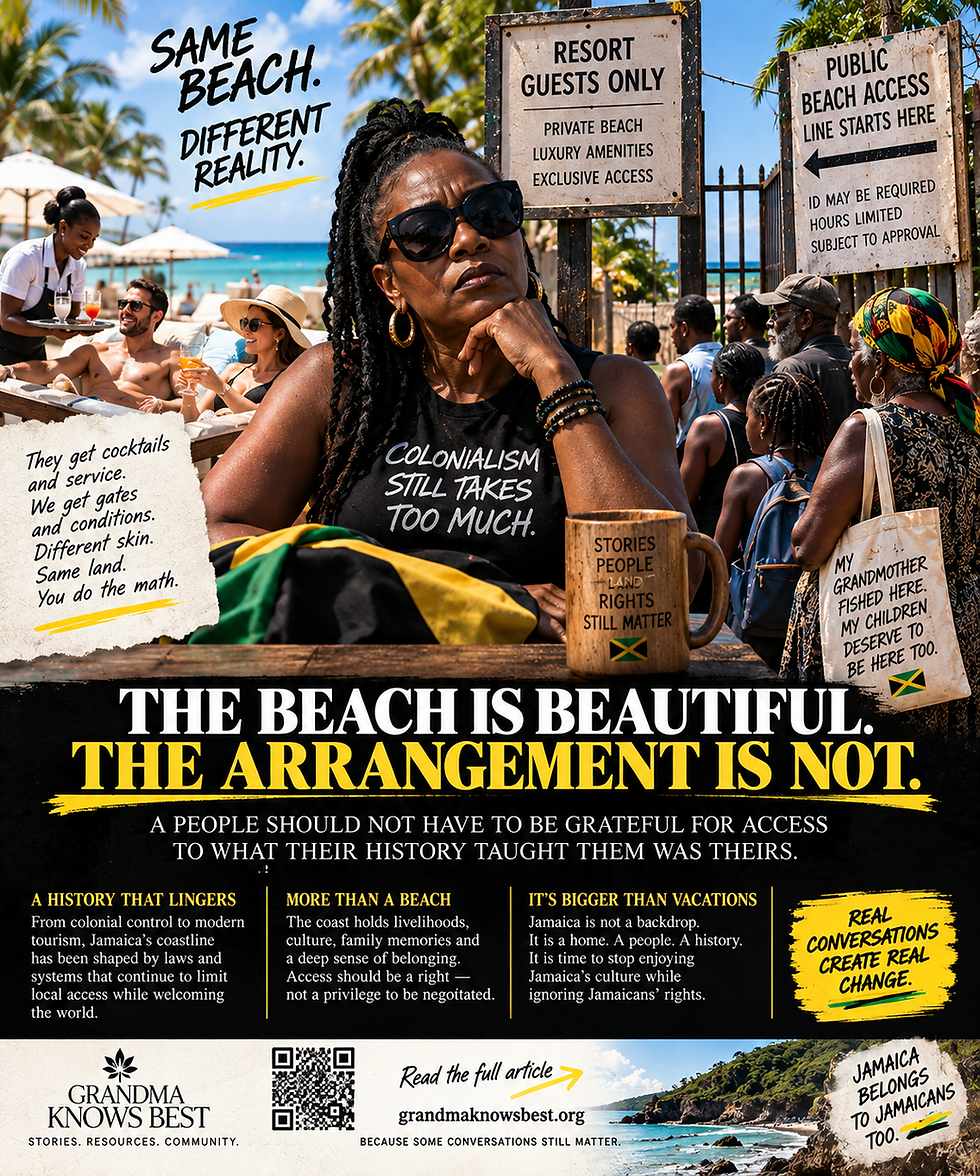
Perhaps the prettiest thing colonialism ever learned to do was hide behind paradise. The beach is beautiful. The arrangement is not.
Sometimes it requires looking at the gate standing in front of us now.
And asking a very simple question:
Who is paradise actually for?
Sources
Jamaica Beach Control Act: https://laws.moj.gov.jm/library/statute/the-beach-control-act
University of Toronto research on beach privatization and access in Jamaica: https://www.utsc.utoronto.ca/news-events/breaking-research/connaught-project-will-explore-beach-privitization-and-access-jamaica
Guardian reporting on Jamaica beach access and plantation tourism: https://www.theguardian.com/news/2026/jun/14/jamaica-beach-access-crisis-plantation-tourism
TIME reporting on discrimination against Africans in Guangzhou during COVID-19: https://time.com/5820389/africans-guangzhou-china-coronavirus-discrimination/
Washington Post reporting on Africans fleeing Ukraine and racism allegations: https://www.washingtonpost.com/world/2022/03/05/ukraine-african-refugees-racism/
Jamaica Observer, government list of 60 beaches it says have free public access (Aug. 19, 2026): https://www.jamaicaobserver.com/2026/08/19/jamaica-lists-60-public-beaches-free-access/
Jamaica Observer, Jamaica Environment Trust call for beaches to be recognised as public commons (Aug. 20, 2026): https://www.jamaicaobserver.com/2026/08/20/jet-calls-jamaicas-beaches-recognised-public-commons/
Jamaica Star / Gleaner, Tourism Minister Edmund Bartlett rejecting the claim that only one per cent of beaches are accessible (Aug. 11, 2026): https://web3.jamaica-gleaner.com/article/news/20260811/tourism-minister-rejects-beach-access-claim-0
Keep following the question
Questions about access, power and who gets erased do not stop at the shoreline.


Comments